In the pre-Spotify days, when dinosaurs roamed the earth, I used to make a lot of variety tapes – “mixtapes” as they’ve come to be known retrospectively, though I don’t think they had that title back then. And this species was a far different animal than today’s ubiquitous “playlists.” Not that I don’t love the unfathomable access and efficiencies that Spotify offers: for music geeks like me, the idea of essentially having the history of recorded music a click away is the rough equivalent of having had the Farrah Fawcett poster come to life to our former 15-year-old selves.
But there was something, I guess you could say, more meaningful, about recording parts of albums (and later CDs) onto cassette tapes. Whereas one can search, click and drag to whip up a Spotify playlist in literal minutes, as well as return to it later to make changes to selections and sequencing, the tape was…a commitment! The notion of being capable of editing a tape was somewhere beyond splitting the atom; if you chose a song, and a placement for it, you lived with it forever. That was a given. And, in order to do so in the first place, you also had to – but, of course – own the actual record! The presence of this “hard copy” being the only imaginable way in which a tape-maker could then proceed to meticulously press “record” and “pause” on a tape deck, over and over and normally for periods of multiple hours or even days, in order to diligently capture and combine these precious songs into some cohesive unit.
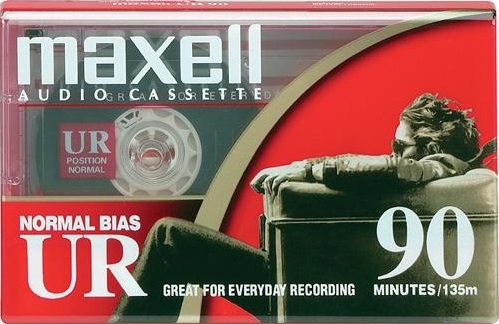
And what about the duration? You want to throw together a dozen songs now and call it a Playlist? Sure, have at it. You need ten hours of driving tunes for a road trip? Coming right up. Not quite one size fits all, but all sizes fit any. But, (now employing an old-man voice) “back in my day” you had to work within the strict and unforgiving confines of either the 60- or 90-minute tape. Properly timing out choices for the expiring end of both Side A and Side B was nothing short of an art form: cut-off a song before its conclusion and stamp yourself a rank amateur, but leave too much dead space – more than 4-5 seconds in my book – and it’s nearly as ruinous. The optimal selection of the suitably-lengthed track to close a side was a daunting and demanding task, best strategized and planned for at least 3 or 4 picks in advance. A good short song was invaluable: numerous sub-2-minute Ramones songs were excellent tools, The Beatles and Creedence were often useful, and in my house, ‘The Entertainer,’ a clown horn and belch-filled knock-off of Scott Joplin by Reverend Horton Heat that clocks in at just 1:14, received an entirely asymmetric number of placements relative to its utter throw-away goofiness.
My son, Max, and I used that one a lot.
Some kids want to have a catch, some want you to play with their toys or read them a book. Max wanted us to tape. As a fairly regular occurrence in his earliest years, I’d return home from a long day’s work and commute, and he’d greet me at the door, having already written out lists of artists and songs onto my special office memo cards, breathlessly asking “Can we tape, dad?! Can we tape?!”
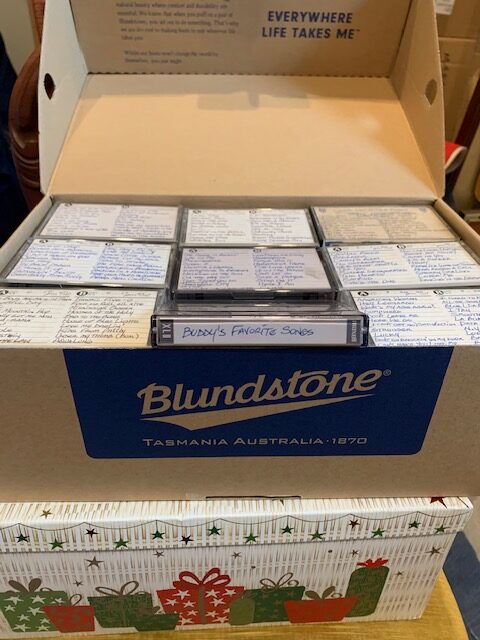
Aerosmith is a band for whom I’ll always retain a soft spot as they were Max’s first favorite band (despite the fact that they were not mine). Along with the rest of their entire discography, the album “Get a Grip,” released the year Max was born, was in constant rotation in the house. Still riding the band’s MTV-fueled renaissance, it would become Aerosmith’s best-selling studio album ever. That record opened with the stomping track ‘Eat the Rich,’ a furiously-paced romp that practically leapt out at me when I recently gave it a listen after happening upon it listed on one of our earliest tape-making productions. The cassette spine, displaying the title “Buddy’s Favorite Tunes,” was dated two months before Max had reached his 6th birthday.
Like ‘The Entertainer,’ ‘Eat the Rich’ also ends with a large burp, a juvenile yet unsurprising connection I’m only just realizing now.
Hearing it definitely jolted me back to the blank cassette era. Back to when trying to weave together a series of seemingly mismatched and imperfectly-timed songs was truly a process, but an honorable challenge worth undertaking. When finalizing a new tape playlist was significant, consequential, and permanent. Those were the days, the glorious mixtaping days.
But damn, I do love using Spotify.


Boris
April 10, 2026 4:19 pmA Reverend Horton Heat reference! Finally!!
So Much Great Music
April 10, 2026 4:33 pmHa! And a suitable article/tribute still to come someday..
Mark
April 11, 2026 9:25 amI still like to make mixtapes sometimes.
So Much Great Music
April 11, 2026 10:47 amBut..on actual cassette tapes?
Kim Shoemake
April 11, 2026 11:23 amI had a specific list I called “Killer Cuts”. It was mostly obscure cuts (to most people) such Rosebud by the Stems. I took particular joy in giving cd’s containing these cuts to my friends, but only under the premise they would tell me which songs they like and which ones they don’t. Always, interesting to hear back. Hope you are well.
Lili Free
April 12, 2026 2:19 amGreat article. Playlists were such a huge part of my life and inextricably linked with falling in love. Whichever bloke I’d fallen for would become my muse and I would spend hours and days compiling the perfect mix tape to convey my feelings. I am a certain neurospicy type – I collected music obsessively and I fell in love obsessively. I ended up with quite a collection (of past love affairs and mix tapes!) I’ve been happily single for a long time now and have made dozens of Spotify playlists (obsessively of course) but you’re right – it’s not the same.
David Wachs
April 12, 2026 8:18 amThanks for that. Evocative, as usual. My recollection…?
(Take a seat) We actually called them compilation tapes back then – I guess you probably did, too. Around 1977–78 there was a real shift happening. Stereo manufacturers began producing much higher-quality hi-fi, both for the home and for the car, and that made a huge difference in how music was experienced. For the first time, that level of sound quality became genuinely accessible to ordinary listeners like us. It became important to us.
At home, we were still listening to what we always called ‘record’ collections – no one said “vinyl” then. And you listened to albums properly, start to finish, flipping them over halfway through. That was simply the ritual of it. Plus, you separated the seeds from the weed on the inside of double albums, as an aside. But with the arrival of better cassette decks and especially the 90-minute chrome or metal tape, something changed: we could finally record an album straight through and not have to interrupt the experience. One full LP on one side of a tape, another on the other. That alone felt revolutionary.
And this is where compilation tapes really began to take shape. We made them mainly for two purposes: road trips and parties.
The road trip tape became its own art form. We were still very much influenced by that lingering late-’60s spirit – the Jack Kerouac sense of movement, escape, and open-road dreaming. So, the music had to match that feeling of space and journey. You’d build tapes around bands like The Allman Brothers, Grateful Dead, Marshall Tucker Band, The Outlaws, Crosby, Stills, Nash & Young, The Band, Little Feat, The Guess Who, The Who, Jorma, Genesis, Traffic, Joni Mitchell, Supertramp, Doobie Brothers, Les Dudek, etc. – those were the kinds of artists that defined the feel of it.
Radio was still a big influence, too. Around NYC at the time you had stations like WPLJ, WNEW and WLIR, which were hugely important because they actually played album tracks – sometimes long ones. It wasn’t unusual to hear long tracks you’d never expect on radio today, like Close To The Edge in its entirety! Radio was our live compilation tape. Finally, we could be our own DJ. Radio fed directly into how we thought about compiling tracks tapes.
Car stereos were evolving just as quickly. By the late ’70s, you could get cassette players built into dashboards, along with graphic equalizers, and proper speaker installations – front and rear, sometimes even tweeters in the dashboard. It wasn’t about giant bass systems like later decades; it was about clean, balanced hi-fi – bass, mid, and treble properly represented. Jeez, I can remember moving from AM to FM, momo to stereo!
Crucially, it sounded so good that your car effectively became a mobile listening room. George and Cubby made a good living installing car stereos during high school, calling their business Turbosound. Evan got his new Honda Prelude (manual) and then a new car stereo installed…with a Pioneer equaliser! Game changer. Life was good. Yes never sounded so good – I’ve Seen All Good People. And The Outlaws ‘Holiday’? Dave Mason ‘Takin’ The Time to Find’? ‘Won’t Get Fooled Again’? ‘Spanish Moon’? ‘Ventura Highway’? We were in heaven. Windows rolled down, turkey, Russian and cole slaw wedge on the ready, an innocent bit of Mary Jane, on the way to Kensico Reservoir for some illegal skinny dipping, pumping out the tunicles, letting the world know…we made it. Oh, to be a teen again.
At home, the shift away from the old all-in-one units was just as important. Those earlier systems (turntable, radio, 8-track, all in one component) were convenient, yet rarely sounded great. Once separates became the norm, proper turntables (like the early Technics direct drives with those signature orange lights), the best stylus, amplifiers, cassette decks, and speakers…the whole listening experience changed.
In fact, in the similar vane, we used to go to The Listening Room in White Plains on Central Avenue, pretend to be potential customers, and ask to hear and experience the top speaker line (faux rich Scarsdalians that we were). We’d request they put on Steely Dan ‘Aja’ for best studio produced example and Little Feat’s ‘Fat Man In A Bathtub’ from Waiting for Columbus for best live album example. As the french doors closed and we sat on a couch centered in the room, you’d hear the little hiss of silence before the track played, then the song would come on and we’d be blissed out of our noodles (and were probably out of our noodles before we even walked in there, to be honest). Love of ‘stereo’ was embedding itself in our friend group.
And the social side of all this was just as important.
For road trips, tapes were often named—”Road Trip,” “Southern Rock Compilation,” “Dead Compilation,” and so on. For parties, it was a different energy entirely: dance tapes, mood tapes, tapes designed for a specific night or gathering. Slow tapes for the gals (Fogelberg, CSN, Bread, Chicago, etc). You’d design them obsessively – what opens, how one track flows into another, and what closes (for when only a little time was left, I found using Elvis Costello & The Attractions for short cuts always came in handy). The segue mattered almost as much as the song choice.
There’s also a funny detail people forget: the practical side of tapes. If they got tangled up, you’d literally fix them with a pencil, wind them back, repair them by hand. There was something physical and slightly fragile about the whole process that made it more engaging. And you always wrote the tracklists by hand, so the object itself carried memory in a very tangible way. You recognised a tape by your friend’s handwriting, too.
Then there was a different type of compilation tape, which was dance tapes or party tapes – made for hanging out, for birthdays, for whatever the occasion was. And I remember in ‘85, as a group of 20 Scarsdalians, we rented out the Presidential Suite at the Omni Hotel in Times Square for New Years Eve. We literally wheeled in a full stereo system in suitcases, speakers and all, along with a lot of booze, food and some Charlie.
And I had made a couple compilation dance tapes for that night, specifically. There was one song on one, ‘And She Was’ by Talking Heads, that was just such an incredible dance track for the time – it was new and fresh. It was so good that I actually put it on twice in a row (a first). I remember thinking, if this comes on and finishes, everyone is going to want to stay on the dance floor and hear it again immediately. So, I put it back-to-back on the tape. It was risky, but felt the right decision. And boy did it go over a storm on the night. Never forget it. Halcyon days (thanks a lot to the NYE compilation dance tapes).
Later on, compilation tapes took on an even deeper personal meaning. I’ve made them for major life moments – pregnancies, childbirth, songs for the kid’s first years. Music became a kind of timestamp for memory, and those tapes ended up being more than just playlists; they became emotional archives.
Now with Spotify and algorithmic recommendations, which are incredible in their own way, something is different. It’s almost too easy. The act of choosing, sequencing, writing it down – that physical investment and involvement mattered, and is missing. Effort equals value.
There was something about the unpredictability and manual aspect of it all. A slightly mangled tape, a handwritten label, cleaning the cassette deck head with alcohol and a Q-tip, a slightly imperfect recording – it all became part of the character of the thing. As I said, if the tape got caught in a player or came out for some reason, it was always important to have a no. 2 pencil handy to roll the tape back in until taught.
I suppose what it really shows is that we weren’t just listening to music – we were actively curating it, shaping it, and physically building experiences around it – an approach to organising our smorgasbord music influences, all mixed together to lift and inspire our hearts, our friends hearts, and the compilation tape was how we served the music-loving cause.
eatapch
April 13, 2026 8:48 amMy in-depth introduction to Zeppelin started with two mix tapes a high school pal made for me, titled “The Masters Play for eatapch, Vol I and Vol II.” Listened to those almost exclusively for months.
And I recall making one in 1989 for my new girlfriend, now wife of almost 36 years. Lots of Derek and the Dominos on that one.
Nice post!
eatapch
April 13, 2026 8:51 amand……some people would get real creative making the cover/song lists for said tapes. Multiple colors and noodling and doodling and so forth.
robert macmahon
April 15, 2026 12:37 pmBG: Love it! I still have almost every mix tape I ever made on display in my Music Room off the basement. So many memories of careful culling and choosing what song(s) would match the overlying theme of the tape. I was still making them as late as the early 2000s. I made a few for my kids when they were born and made sure they still had them when they first moved out. It meant more to me than to them, but I knew that (and so did they). I miss those days. Time is evaporating yet music is still life, my friend.! RMac